RAINY DAY HISTORY
  • home
  • all entries
  • about
  • home
  • all entries
  • about
Search by typing & pressing enter

YOUR CART

11/15/2023 0 Comments

Why is this here? A Historical Look at the Pioneer Square Totem Pole

By Justin L. 
​
Editor’s note: This piece was created during the 2023 session of 
History Lab, a summer intensive for high school students interested in local history and storytelling. Over the course of two weeks, participants explore creative ways to interpret and share history, conduct research, and produce a work of historical interpretation in a digital medium on a topic of their choosing. 
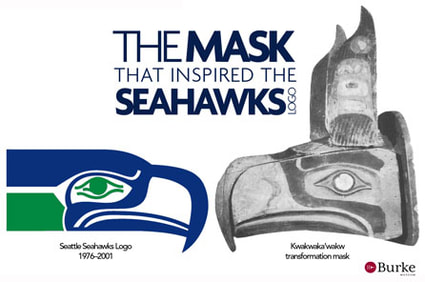
When you are in Seattle, look around you and try to notice the numerous public structures, place names, and icons with roots in Native American culture. The city itself named after Seathl, a Duwamish and Suquamish chief who allegedly delivered a stunting dissent against his colonizers; smoked salmon, which has sustained the lives of the Duwamish for centuries, and still does; the Seahawks? Its logo is based on a Native mask! What about the first totem pole park in America, located in our own backyard of Pioneer Square? [1] 

I am absolutely fascinated by the vice-like grip that this city has upon Native culture, especially when no other ethnic group seems to be under such a spotlight. In this exploration, I would like to invite you to join me on a journey to understand the curious presence of Native American art in Seattle’s public spaces, by taking a look at the Pioneer Square totem pole, one of the city’s oldest public works of Indigenous art.
Picture
Image from the Burke Museum website
Picture
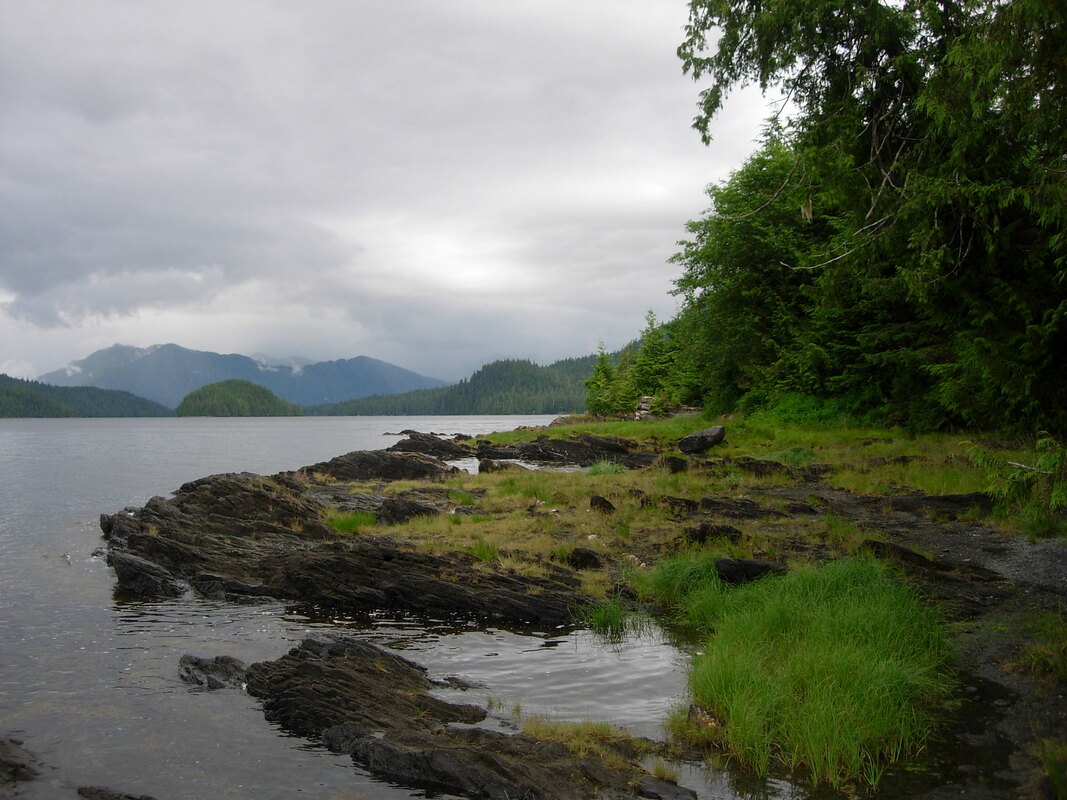
Tongass National Forest in 2007; photo by Mark Brennan via Flickr https://www.flickr.com/photos/funkadelic/1032051845
Carved in 1790, tucked in the rugged fog of Alaska’s Tongass Island, the 50-foot totem pole that would land in Seattle’s Pioneer Square belonged to the Kinninook family of the Ganaxádi Raven clan. It was carved to commemorate the Chief-of-All-Women who drowned in the Nass River while on a journey to visit her ill sister. The totem pole was crowned with an overbearing sculpture of the Raven-at-the-Head-of-Nass, which in Tlingit mythology, “did everything, knew everything, and seemed to be everywhere at once.” [3] For close to a century, the pole stood as a reminder to the Tongass Tlingits of the clan’s origins and social standing. [2] 
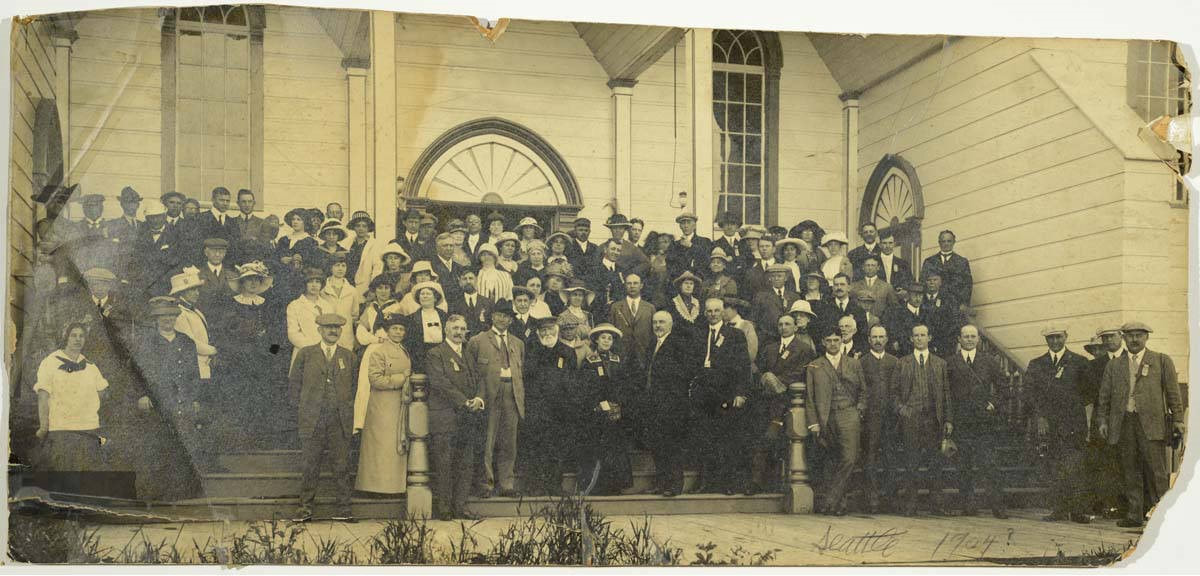
The grand design, to its own detriment, captured the hungry gaze of Seattle’s most renowned clergymen, land developers, and bankers known as the Chamber of Commerce. [2] In August 1899, 165 of these city visionaries were on board the steamship City of Seattle, on a tour for business development and recreation chartered by the Seattle Post-Intelligencer. [3] Stopping at nowmajor cities like Vancouver and Victoria, their journey also included a stint at Tongass to see the longhouses and poles of the Tlingit up close [4].
Picture
Members of the Seattle Chamber of Commerce in 1904. MOHAI, SHS9796.
In classic ask-for-forgiveness-not-permission mentality, this “Good Will Committee” of “leading Seattle citizens” took the towering pole to bring back to their city. [4] While one might expect  physical violence or deceitful manipulation from such an event, none was reported by the expedition party. Just the audacity of showing up on strangers’ shores and treating their home like a souvenir shop. According to an account by  third mate R. D. McGillvery, “the Indians were all away fishing, except for one who stayed in his house and looked scared to death. We picked out the best looking totem pole... we chopped it down - just like you'd chop down a tree. It was too big to roll down the beach, so we sawed it in two.” [3] In a lawsuit filed months later by the original owners of the totem pole, James Clise who was the ringleader and Acting President of the Commerce responded that “there were two decrepit Indians which we finally succeeded in interviewing, who made no objection to our taking the pole to Seattle.” [3] ​
Picture
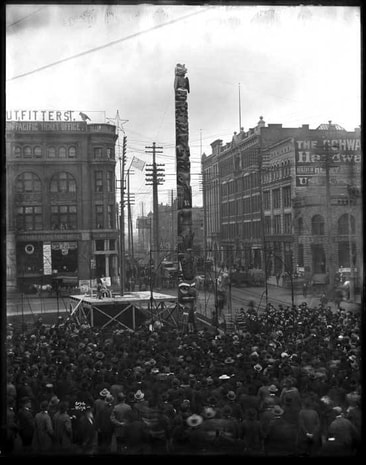
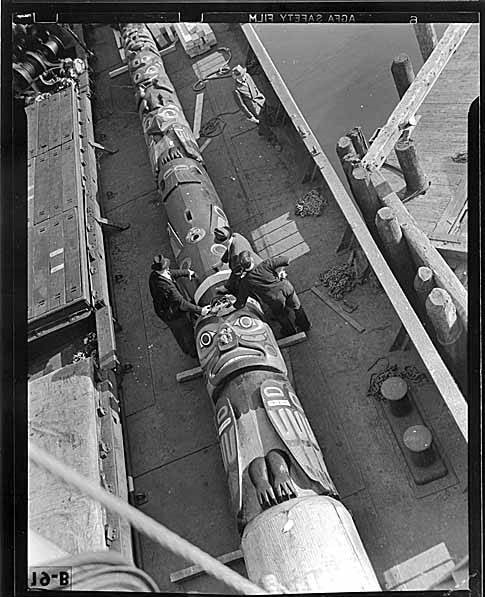
Seattlelites gather to view the installation of the pole. Anders Beer Wilse Photographs, MOHAI, 1988.33.146
Picture
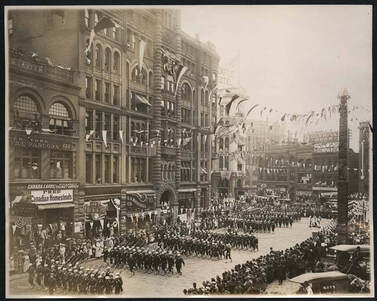
Bustling Navy parade during the Golden Potlatch in 1911, a city-wide festival organized by civic boosters hoping to capitalize on the success of the AYPE, with the totem pole in the background on the right. Seattle Potlatch Photograph Albums, MOHAI, 2011.79.1.27
For these men, the pole served as a trophy of their successful expedition. For the numerous Seattlelites who beamed at the erection of this totem pole, it served as a symbol of patriotism and immense pride [6]. But, considering that Coast Salish tribes (the Native people whose lands are in and around the Seattle area) never traditionally made totem poles as a part of their culture [7], patriotic pride didn't actually mean honoring the ancestral owners of the land. The fact that the pole held such cultural significance to the Tlingits up North but was in the possession of urbanites who had no personal history with it reflected the ambitions and wide-reaching influence of the city. In the words of historian Coll Thrush, “Seattle had looked North and found a totem pole.” [2] What speaks more power than wanting something, then getting it? In modern terms, we call that imperialism. 
On October 18, 1899, the Chief-of-All-Women totem pole was erected in Pioneer Square.  An orator, playing the internal monologue of the pole itself, narrated, “While all the other [totem poles] of my kind / Are slowly settling on their stems / Among the salmon scented Silences, / I [the Pioneer Square pole] stand, incomparable.” The pole was evidence of its new owners’ vision for Seattle as a Gateway to Alaska [2]. After the arrival of gold on the steamer Portland in 1897, Seattle was booming with businesses “mining the miners” headed to the Klondike. and. [2] The pole helped advertise the city as the Gateway to Alaska, conjuring images of a faraway place. The rustic nature of the pole was meant to stand out  against the backdrop of a rapidly advancing city. Even non-miners flocked to the gateway city; as Seattle was becoming increasingly urban, many tourists came “in search of exotic Others who called the northwest wilderness home.” [2] Naturalist John Muir describes, “There was a grand rush on shore to buy curiosities and see totem poles…The shops were jammed and mobbed, high priced being paid for shabby stuff manufactured expressly for the tourist trade.” [2] 

​A month after the totem pole was installed in Seattle, in November 1899, William Kinninook, of the family who owned the pole, filed a lawsuit against eight of the expeditioners and the 
Post-Intelligencer claiming for $20,000 in reparations. [5] Soon after the lawsuit was filed, it was ultimately dismissed after the newly appointed U.S. District judge for Alaska stopped for dinner at the Rainier Club and was adequately entertained in Seattle. The  Tlingits settled for a payment of $500 to the Kinninook family, which the Seattle Post-Intelligencer paid. [3] ​
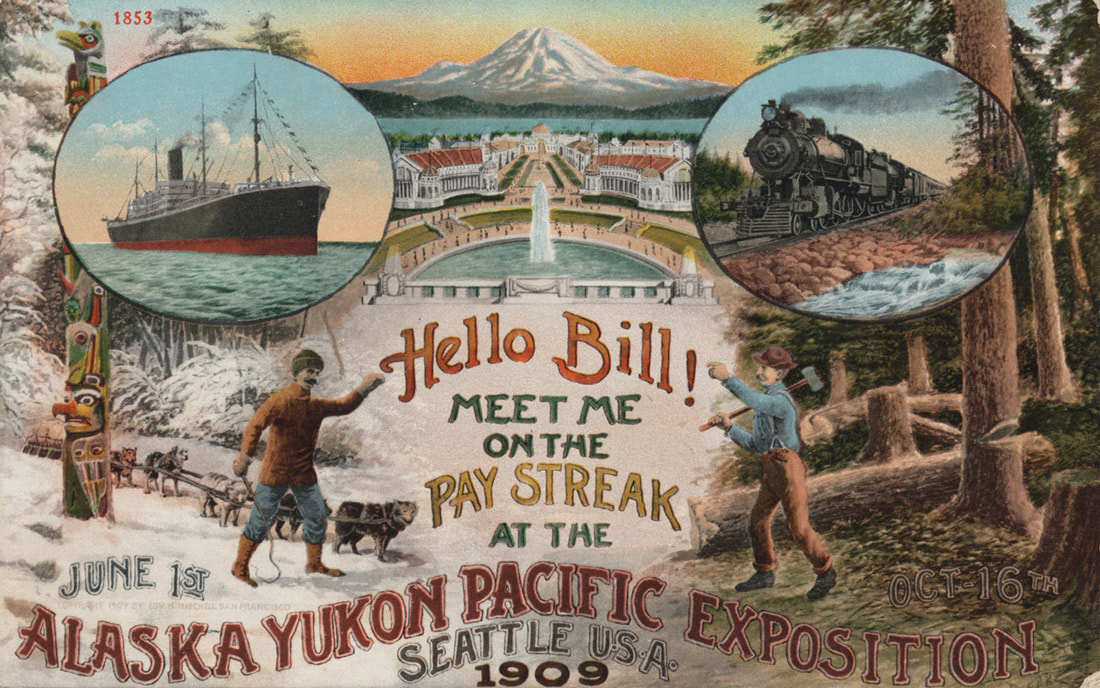
Attorney William H. Thompson, speaking on behalf of his eight defendants, justified the act saying that “here [in Seattle] the totem will voice the natives' deeds with surer speech than if lying prone on moss and fern on the shore of Tongass Island.” [3] To state this presumes that not only does Native culture belong to all Americans, but also that the preservation of Native culture requires the magnanimous aid of white people, who will truly appreciate and help elevate its worth. Both are untrue, but these beliefs were on full display at the Alaska-Yukon-Pacific Exposition (AYPE) of 1909, where the totem pole served as a poster child for the first world’s fair hosted in Seattle, the ‘City of Totems’. ​
Picture
AYPE promotional postcard; the totem pole in the background on the left. MOHAI, 1966.4058.8
In this world fair, “the message was clear: these Indians were our people–not in the sense of being us, of course, but in the sense of being ours.”[2]  Children from the Tulalip boarding school were put on display to promote the Bureau of Indian Affairs; Native and non-Native people alike were hired to inhabit recreations of ‘primitive’ villages Alaska and the Philippines; others were hired to perform in wild west shows. 

While it is easy to completely dismiss these aspects of the AYPE as shameful and unacceptable, many Native people had pragmatic reasons to attend, and they were rewarded economically and/or socially for participating in their own exploitation. Many upsold their artifacts to ignorant tourists for a cushy profit margin; some Native women outcompeted several white women in the beauty pageant, winning several lots of land in suburban Seattle; the exposition also served as a middle ground to shame long-standing rivals between Native communities or conversely, create alliances; and of course many Native people came purely for entertainment[2] 
The fair positioned Seattle as a shining city on the edge of a vast American empire. In the face of unprecedented growth of the Seattle economy, those who were wistful for the pastoral past became fascinated with the wilderness, and romanticized it. This was an untapped market, Seattle noticed. Positioning Native people and culture at the fair as backwards, exotic, and mysterious helped communicate to fairgoers that Native land was their visit and take from, and Seattle was their Gateway to the North. It offered the adventure of a lifetime, and was the frontier to a spectacle. 

The ways Native people were on display at the fair, however, was not simply harmless fascination. It chipped away at Native sovereignty, and actually reflects hatred. Roxanne Dunbar-Ortiz and Dina Gilio-Whitaker, co-authors of “All The Real Indians Died Off” and 20 Other Myths About Native Americans, bust the myth that all “Native American Culture Belongs to all Americans.” They note that scholar Rayna Green is one of the first to use the concept “Playing Indian”, to unpack the ways in which Americans’ obsession with the “vanishing race'' at times “translated into trying to become them, or at least using them to project new images of themselves as they settled into North America.” [8] Seattlelites did not love Native culture. They pitied upon Native culture because compared with their industrialized standards of living, they saw Native people as noble savages stuck in the past. And by co-opting their culture and ‘ownership’ of the wilderness, they sought to replace them. ​
Picture
Closeup photograph of the 1940 replica of the totem pole. Seattle Post-Intelligencer Collection, MOHAI, 1986.5.15007
Seattle is a bustling city with a culture that visibly owes much to Native people, and I believe that is what makes this city stand out. This is exactly what piqued my interest in learning more about the pole in the first place! But totem poles have become an ironic representation of our city’s complicated history and attitudes towards Native people and their culture: not traditionally made here but now entertwined with its identity to such an extent that Coast Salish artists began carving smaller story poles in the 1920s and 30s. [7] However, I am afraid that some people who are unaware of Seattle’s history with appropriation and cultural erasure might write this off as consensual cultural exchange. 

Because Seattle has a reputation as a progressive city, it would be easy to forget that its local history also includes its fair share of deceit, disenfranchisement, and injustice. We should acknowledge the theft, and deprecation, and misinformation that occurred (and still occurs) to Native people, land, and culture. The actions taken by the early pioneers of this city were selfish and reflect their disregard for Native people. Though Native culture is increasingly appreciated and present in our cityscape, it is important to know that this wasn’t always the case, and it was exploited in a deprecative way to advertise this city. The Pioneer Square totem pole does not represent a gift, but a theft;  Although the totem pole that still stands is a replacement ode to the original (which was burned and its remnants returned), many Seattleites would like for the city’s public Native art to better reflect and respect our local tribes [9]. In the meantime, the pole stands tall, and carries the story of the Chief-of-all-Women, exemplifier of womanhood. ​
Footnotes: 
  1. Garfield, Viola E. Seattle’s Totem Poles. Thistle Press, 1996. https://archive.org/details/B-001-001-161/page/n3/mode/2up?view=theater.
  2. Thrush, Coll. Native Seattle: Histories from the Crossing-Over Place. Second. University of Washington Press, 2017.
  3. Wilma, David. “Stolen Totem Pole Unveiled in Seattle’s Pioneer Square on October 18, 1899.” HistoryLink (blog), n.d. https://historylink.org/File/2076.
  4. The Seattle Post-Intelligencer. “The Business Men’s Excursion Departs.” August 18, 1899, Vol 36 No 94 edition, page 1. https://www.newspapers.com/image/333655288/ 
  5. Moore, Emily L. Proud Raven, Panting Wolf. University of Washington Press, 2020. 
  6. Jonaitis, Aldona. Discovering Totem Poles: A Traveler’s Guide. University of Washington Press, 2012. 
  7. Wright, Robin K. “How Did Totem Poles Become a Symbol of Seattle?” Burke Museum (blog), November 19, 2015. https://www.burkemuseum.org/news/how-did-totem-poles-become-symbol-seattle. 
  8. Dunbar-Ortiz, Roxanne, and Dina Gilio-Whitaker. “All the Real Indians Died Off” And 20 Other Myths About Native Americans. Beacon Press, 2016.
  9. Reyna, Luna. “Renewed Effort to Remove the Misleading Totem Poles at Pike Place Park.” Crosscut, July 1, 2022. https://crosscut.com/news/2022/07/renewed-effort-remove-misleading-totem-poles-pike-place-park.
​
0 Comments

Your comment will be posted after it is approved.


Leave a Reply.

    Categories

    All Places And Spaces Profiles Then And Now Youth Activism

    Archives

    August 2025
    January 2024
    November 2023
    October 2023
    September 2023
    August 2023
    February 2023
    November 2022
    October 2022
    September 2022
    August 2021
    July 2021
    May 2021

    RSS Feed

Follow us on Instagram!
Listen to the podcast and find show notes at mohai.org