RAINY DAY HISTORY
  • home
  • all entries
  • about
  • home
  • all entries
  • about
Search by typing & pressing enter

YOUR CART

10/16/2023 0 Comments

Interactive: Women of Seattle Arts

Editor’s note: This piece was created during the 2023 session of History Lab, a summer intensive for high school students interested in local history and storytelling. Over the course of two weeks, participants explore creative ways to interpret and share history, conduct research, and produce a work of historical interpretation in a digital medium on a topic of their choosing. For her project, Nora created a web interactive that spotlighted four different women artists/organizations from a variety of artistic disciplines and time periods. 
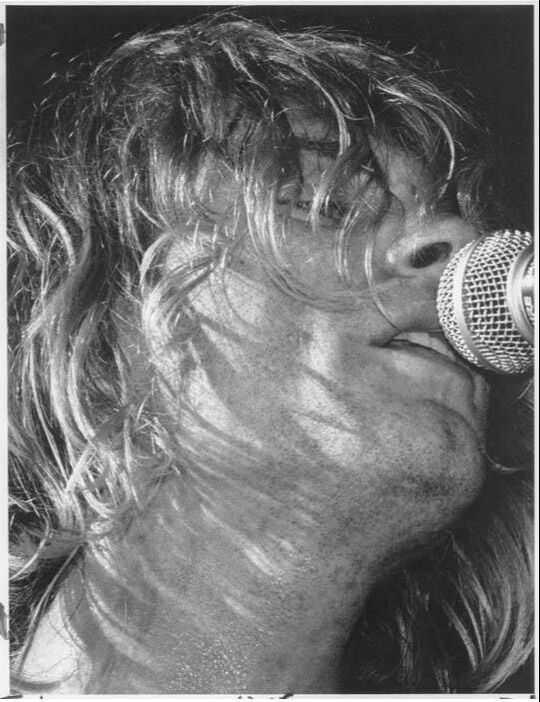
This year's History Lab was inspired by the Museum of History and Industry exhibit Celebrating Pacific Northwest Artists: 25 Years of the Neddy Awards. As a participant, I was prompted to incorporate Seattle art and artists into my research project. As someone who has lived just outside the city her whole life, I wanted to focus on the diverse types of art that have been produced by local artists. As I began research, I started to look up parts of Seattle’s art scene and lesser known stories of artists. The first one I found was Tina Bell. Bell’s story fascinated me as I found it so bizarre that someone who seems so influential could be so relatively obscure. That led me to focus on other women who have helped to shape Seattle’s art scene. Before this project I was oblivious to each of the women I chose to write about. I found it curious that I hadn’t heard of any of them when they all have a huge legacy in Seattle and the Pacific Northwest. Throughout this project I noticed similarities between all these women and how they’ve each been challenged with being underrepresented in their fields. I created this project in order to highlight and showcase their unique stories and accomplishments that so more people can learn about them. I hope that this helps to bring to light their talents and contributions to the arts.
​- Nora
Picture
Access the Interactive
0 Comments

9/5/2023 0 Comments

True Northwest: A Musical Journey

This series of Rainy Day History bonus episodes were designed to provide a soundtrack to your MOHAI experience and are best listened to as part of the playlist below. If you’re at the museum, we encourage you to pop in some headphones and listen to the introductions and curated songs while you walk through MOHAI’s core exhibit, True Northwest: The Seattle Journey. 

In this playlist, MOHAI Youth Advisors Chelsea and Charlee will introduce three musical pairings hand-picked to complement your exploration of a specific section of True Northwest, then you will get a chance to listen to the songs. Join us on a musical journey through Seattle history!

Show Notes: 

Episode Transcripts: 
  • Part 1
  • Part 2
  • Part 3

Sources: 
  • Chang, Ailsa and Dave Blanchard, “'We Will Always Sing': Black Belt Eagle Scout Makes Space For The Marginalized”. NPR, All Things Considered. September 9, 2019. https://www.npr.org/2019/09/09/759130275/we-will-always-sing-black-belt-eagle-scout-makes-space-for-the-marginalized. 
  • Pamyua’s website: http://www.pamyua.com/
  • Quincy Jones on HistoryLink https://historylink.org/File/10354 
  • Jimi Hendrix on BlackPast https://www.blackpast.org/african-american-history/hendrix-jimi-1942-1970/ 
  • Alice in Chains on AllMusic https://www.allmusic.com/artist/alice-in-chains-mn0000007920/biography 
  • Sir Mix-a-Lot on AllMusic https://www.allmusic.com/artist/sir-mix-a-lot-mn0000011475/biography

Explore more: 
  • Listen to other musical episodes of Rainy Day History! 
    • Season 1 - A Voice Like Honey At Dusk
    • Season 2 - I Need the Volume Higher
  • Check out music-related items in the MOHAI online collection
0 Comments

8/28/2023 0 Comments

Rainy Day History Bonus Episode: Seattle Authors

A podcast episode by Karly

Editor’s note: This piece was created during the 2022 session of History Lab, a summer intensive for high school students interested in local history and storytelling. Over the course of two weeks, participants explore creative ways to interpret and share history, conduct research, and produce a work of historical interpretation in a digital medium on a topic of their choosing. ​
What makes Seattle a great place to write and to write about? Learn about three writers past and present whose work has shaped and been shaped by the city. ​
Episode transcript
Bibliography
Music: "Good Morning St. Martin" by Aldous Ichnite; Source: Free Music Archive, CC BY-NC license. 

Author Links:
https://www.octaviabutler.com/
https://www.lindywest.net/
https://washuta.net/

About the podcast: Rainy Day History
​
0 Comments

2/1/2023 0 Comments

Humbows Not Hot Dogs: the CID Preservation Movement

A webzine by Jasmine Z. 

Editor’s note: This piece was created during the 2022 session of History Lab, a summer intensive for high school students interested in local history and storytelling. Over the course of two weeks, participants explore creative ways to interpret and share history, conduct research, and produce a work of historical interpretation in a digital medium on a topic of their choosing. ​
0 Comments

11/4/2022 1 Comment

Aki Kurose: A Life Remembered

By: Nathan D.
​

Editor’s note: This piece was created during the 2022 session of History Lab, a summer intensive for high school students interested in local history and storytelling. Over the course of two weeks, participants explore creative ways to interpret and share history, conduct research, and produce a work of historical interpretation in a digital medium on a topic of their choosing. 

Growing up in the Central District

Picture
Image 1: Aki Kurose during her time in college (Courtesy of Densho, the Kurose Collection)
Aki Kurose (born Akiko Kato, 1925) grew up in the Central District of Seattle, a diverse community with neighbors who were of Chinese, Jewish, African American, and Japanese descent. Later in life, Kurose remembered the neighborhood fondly, describing it as friendly and happy. She knew her neighbors and local shop owners well, and even kept in touch with them many years later. Speaking about this time in an oral history she said, “We just had a good time, you know, always interacting with them” (the neighbors, the bakers, the other tenants). “We [celebrated the] Jewish holidays as well as [the] Japanese holidays… [On] Passover, people are cleaning the house and my mom thought that was a wonderful idea.” Looking back on her life at the time she said “I was just a happy-go-lucky person…And never did it occur to us that we would be ever considered anything but an [American].” [1] But all of this changed on December 7th 1941, the day Japan bombed Pearl Harbor. 

After Pearl Harbor

At that time, Kurose was in her senior year at Garfield High School, and the next day she remembers a teacher saying to her, “Your people bombed Pearl Harbor.” As those words hit her, she suddenly became very aware of her “Japaneseness,” “not in a real positive way, but kind of a scary way,” she remembered. She no longer felt like an equal American anymore. [2]
Picture
After “Camp Harmony”, Aki and her family were sent to the Minidoka War Relocation Center, pictured above, now a historical site. (Courtesy of the Wing Luke Asian Museum, the Hatate Collection, Number 1992-41-4 R)
Months later, on February 19th. 1942. President Roosevelt wrote Executive Order 9066 which authorized the exclusion of “any and all persons” from living in established “military zones”. [3]This resulted in the forced removal of Japanese immigrants and Japanese American cities from their homes along the West Coast to incarceration centers monitored by the military. [4]
 

Aki’s entire family was first moved to the Puyallup Assembly Center (located on the Puyallup Fairgrounds, and called “Camp Harmony” by army officials), along with other Japanese Americans ranging from Western Washington to Alaska. The barracks and shower stalls at the detention facility were mostly communal. Aki, who was raised to be very modest and private, recalled this being “devastating”. [5] The temporary structures were poorly constructed; some were converted animal stalls, and they had no insulation. Aki also remembered, “they gave us army cots and then they gave us these bags and we were to stuff them [with hay] for mattresses…But my sister, Suma, was very asthmatic, so that was terrible. She could not survive with the straw mattresses, you know. And so she spent a lot of time in the hospital in camp, because of her asthma. And [the] medical care was not that adequate either.” [6]

After a few months at Puyallup, her family was transferred to the “Minidoka Relocation Center,” in Idaho. The detention center wasn’t finished when incarcerees first arrived, but at least it seemed more stable than the barracks in Puyallup, Aki remembered. “This time they gave us army mattresses, so we didn't have to stuff mattresses when we went there. And there were still the steel army cots and we had to arrange the six beds so that there'd be space enough for us to move around. And then there was the mess hall, which was more permanent-looking than what we had in Puyallup. And so, we said, "Well, I guess this is where we're going to stay for awhile." [7]


Over 13,000 inmates were incarcerated at Minidoka, most originally from urban areas like Seattle and Portland. Many inmates tried to make the best of their situation. The only positive aspect of life at Minidoka, Aki remembered, was “the togetherness
and the community spirit”. There was limited self-governance through an elected camp council, and inmate-led religious services, recreation activities, and a co-op. [8] “We had community singing. And just, then later on they did community dances in the mess hall, you know. And so, that we felt the bonding and the togetherness. And I thought that was good and people were helping each other, and friendly.” [9] Eventually schools were set up in the detention center, and Aki was able to get her high school diploma while incarcerated, though she said it was uneventful. [10] 


A lifelong friendship

One of the people that was important to Aki Kurose’s life was Floyd Schmoe, a naturalist and Quaker activist who protested the incarceration of Japanese Americans both during and after the war. 
Picture
Image 3: The first page of a Japanese American resettlement handbook by the American Friends Service Committee. (Courtesy of the American Friends Service Committee Archives)
At the time Executive Order 9066 was announced, Schmoe was teaching at the University of Washington, and quit his job to set up the American Friends Service Committee, which organized aid to Japanese and Japanese Americans who were being relocated. The AFSC helped local students find other colleges and universities in the Midwest and East Coast to transfer to, and helped families pack and store their possessions. During the war, Schmoe and his wife visited the camps, took photographs, and wrote about conditions. After the detention centers closed, Schmoe and the AFSC helped resettle incarcerees. [11] It was while doing this work that Aki and Floyd first met. The AFSC helped college-aged incarcerees acquire leave from the camps to go to school. Schmoe helped Aki attend the University of Utah before returning to Seattle after the Executive Order was lifted.  [12]
Aki recalled of Floyd, “He was a professor at the University of Washington, a forestry professor. And he housed many Japanese students that came from Yakima, Wapato, whatever. The family always took in students. And I started attending Friends Center -- Friends meeting, which is church. And he just kind of adopted me, and said, "Hey, you're going to be our daughter." And so I'd go in and out of his house all the time. And his wife was very, very nice, and I got to know the whole family.” Aki even lived with the family of Ruth, Floyd’s wife, in Kansas when she went to Friends University for her freshman year of college. [13]

​They worked together and remained lifelong friends. “He is just the most uncanny person I've ever known,” Aki once said. “He's very bright, very giving; he's just a very nice person. And I think I feel real honored to be his friend.” Floyd was even with Aki the night she died. At that moment he recalled “All I remember saying, over and over again, "We love you, we love you." [14]
Picture
Image 4: Floyd Schmoe (back left) and Aki Kurose (center) with the Hiroshima Peace Prize (Courtesy of Densho, the Yanagihara Collection)

Life after the war

After graduating college in 1948, Aki got married and got involved in peace activism through her work with the AFSC. “I realized what war can do and the injustices that occur [because of] war. There is no justice when war takes place. And my folks emphasized the fact that [our] incarceration was due to war, this was an injustice due to war. And that we should always make sure that there is no more war, and we should work for peace.” [15]
​

Through AFSC, Kurose also got involved in the local open housing movement in the 1950s, which fought to remove discriminatory housing practices that resulted in segregation. In the 1960s, Kurose joined efforts led by the Congress for Racial Equality (CORE) to desegregate schools, housing, and unions. During this time she and other parents in the neighborhood worked together to start a preschool which became the first Head Start program in Washington State. It was this experience that led Kurose to decide to become a teacher.  [16]

When Kurose began teaching in 1974, Seattle was beginning an effort to desegregate its schools through busing, but also staffing mandates. She recalls, “they were desegregating the schools and it came to the attention of the school board that the staff was not desegregated.” And so the Department of Health, Education, and Welfare (HEW) released a mandate that “no minority teacher could teach in a minority impacted school,” and Kurose was transferred from the predominantly Black MLK Elementary School to the mostly white, affluent Laurelhurst Elementary, replacing a beloved teacher in the process. [17]

The parent community was very resistant to the transfer. She said, “There was one parent that came and said, "You know, the only reason you have this job is because you're a minority, I don't think you're a good teacher at all, the only reason you have this job is you're a minority, and you've displaced and replaced one of the best teachers in the district." [17] 

Although she was heavily criticized as a minority teacher at predominantly white school, she eventually became one of the most loved and respected teachers. “Some of my greatest critics became my strongest advocates,” she said. She was awarded Seattle Teacher of the Year in 1985, and after her death a Seattle middle school was named in her honor. [18]

What Aki Kurose means to me

This was how I learned about Aki Kurose, as a 7th grader at that exact school, where there is a glass display case containing an exhibit about her life’s work. Reading about her legacy, I admired what she was able to do with her life. Her experience in the incarceration camps led her to to fight for peace and against discrimination afterwards. Learning about her also changed my perspective on history, teaching me to make sure I got all narratives of a story, so that I can form my own opinion. 

Although throughout my life, I have felt lucky not to experience being stereotyped a lot, reading articles about the slander and violence against Asian Americans during the pandemic made me sad. Thoughts crept into the back of my head like feeling that this kind of behavior is considered acceptable by society. Or that even if they don’t say anything to your face or do anything, people may be judging you if you cough close to them. You are aware that people may be judging you just by your appearance or background. 

And like Aki, I feel empathy for others. If you take homelessness for example, there are people that are suffering without a home and who are not treated with the same respect as others. They are given weird looks, and others assume things about them. Through her work she was able to help fix injustices. Her story inspired me to advocate for change.

This piece relied heavily on oral histories conducted with Aki Kurose and Floyd Schmoe for Densho. Many thanks to all involved in sharing and preserving these stories for future generations. To read, watch, or listen to more interviews and stories of the Japanese American incarceration experience from those who lived it, visit the Densho Digital Repository at https://ddr.densho.org/ 

Footnotes: 

  1.  Kurose Interview I, Segment 4
  2.  Kurose Interview I, Segment 13
  3.  Executive Order 9066 
  4.  Brian Niiya. "Executive Order 9066," Densho Encyclopedia
  5.  Kurose Interview I, Segment 5
  6.  Kurose Interview I, Segment 16
  7.  Kurose interview I, Segment 18
  8.  Brian Niiya. "Minidoka," Densho Encyclopedia 
  9.  Kurose Interview I, Segment 20
  10.  Kurose Interview I, Segment 19
  11.  Mayumi Tsutakawa. "Floyd Schmoe," Densho Encyclopedia 
  12.  Jennifer Ott. “Aki Kurose” HistoryLink
  13.  Kurose Interview I, Segment 22
  14.  Schmoe Interview I, Segment 5
  15.  Kurose Interview I, Segment 25
  16.  Jennifer Ott. “Aki Kurose,” HistoryLink
  17.  Kurose Interview I, Segment 26
  18.  Nancy Matsumoto. "Aki Kurose," Densho Encyclopedia ​

Bibliography

Transcript, Akiko Kurose Interview I, 17 July 1997, (Full). Densho Digital Archive. https://ddr.densho.org/interviews/ddr-densho-1000-41-1/ 

Transcript, Floyd Schmoe Interview I, 10 June 1998, (Full). Densho Digital Archive. https://ddr.densho.org/interviews/ddr-densho-1000-83-1/ 

Executive Order: https://catalog.archives.gov/id/5730250  

Matsumoto, Nancy. "Aki Kurose," Densho Encyclopedia https://encyclopedia.densho.org/Aki%20Kurose

Niiya, Brian. "Executive Order 9066," Densho Encyclopedia https://encyclopedia.densho.org/Executive%20Order%209066

Niiya, Brian. "Minidoka," Densho Encyclopedia https://encyclopedia.densho.org/Minidoka

Ott, Jennifer. “Aki Kurose,” HistoryLink. https://www.historylink.org/File/9339 

Tsutakawa, Mayumi. "Floyd Schmoe," Densho Encyclopedia https://encyclopedia.densho.org/Floyd%20Schmoe

Image citations: 
  • Image 1: "Aki Kurose at Friends University, c. 1946-1947, Wichita, Kansas.." Densho Encyclopedia. 18 Nov 2020. Accessed 12 Aug 2022. https://encyclopedia.densho.org/sources/en-denshopd-p104-00008-1/.
  • Image 2: "Two children in camp, c. 1943, Minidoka concentration camp, Idaho.." Densho Encyclopedia. 18 Nov 2020. Accessed 12 Aug 2022. https://encyclopedia.densho.org/sources/en-denshopd-i39-00044-1/.
  • Image 3: “Japanese Internment Resettlement Handbook, 1942.” American Friends Service Committee, 4 Feb. 2016, https://www.afsc.org/document/japanese-internment-resettlement-handbook-1942#modal-thumb-14903.  
  • Image 4: "Floyd Schmoe receiving the Hiroshima Peace Prize, 1988, Seattle, Washington.." Densho Encyclopedia. 18 Nov 2020. Accessed 12 Aug 2022. https://encyclopedia.densho.org/sources/en-ddr-densho-26-5-1/.
1 Comment

10/21/2022 0 Comments

Hiking Through History

a webzine by Vedika
0 Comments

9/6/2022 0 Comments

The History of Seattle's Coffee Culture

Written by Karen.
Picture
Barista Jeffrey Kirihara working at Nordstrom's espresso bar, July 12, 1990. MOHAI, Seattle Post-Intelligencer Collection, 2000.107.039.02.05

Introduction

When the city of Seattle is mentioned, some of the first things that come to most people's minds are rain, the Space Needle, and of course, coffee. The birthplace of Starbucks and home to a variety of coffee houses, Seattle is full of rich coffee culture and its influence has spread across generations. From year to year, Seattle usually finds its way somewhere in the top 10 or top 5 cities for coffee lovers.[1] A 2020 study found that there are 56 coffee shops per 100,000 residents.[2] The city also has the highest ratio of Starbucks cafes per capita - around one café for every 4000 people.[3] Seattle’s cold, rainy weather makes it the perfect place to sip a warm cup of freshly brewed coffee. There's just something about being subjected to the soggy weather the majority of the year that makes having a warm cup of coffee in your hand a must. The extra jolt of caffeine, the idea of getting cozy at a café, and the seasonal comfort. 

General Coffee House History

Coffee Houses are a staple of modern society. Jonathan Morris, coffee historian, has identified the following key moments in the history of modern coffee houses, beginning in the Ottoman Empire in the mid-1500s.[4] Liquor and bars were banned to most practicing Muslims - coffee was deemed a legitimate non-intoxicating drink by religious officials, and Ottoman coffee houses provided a democratic space for Muslim men to gather and socialize outside the mosque.  Coffee culture developed rapidly, and coffee houses quickly became known as meeting places for political discussion. Coffee’s affordability and accessibility eroded centuries of social norms of social class. By the early 1500s, coffee shops were outlawed by Ottoman officials, as they believed that the gathering places encouraged disruption of ruling in the country. Coffee then spread throughout Europe in the mid-1600s, primarily through metropolitan cities like Vienna, London, and Paris. In Europe, the process of adding milk, cream, and sugar was introduced. Just like in the Middle East, European coffeehouses were used to enable patrons to stage debates, read the local paper, and converse. From the 1850s to the 1950s, coffee was transformed into an industrial product in the United States. Coffee houses spread to the Americas early on in their colonization. After the Second World War, coffee became a global commodity.

Seattle Coffee History

Where did Seattle get its affiliation with coffee from? Seattle has a long history of coffee, beginning with roasteries selling out of Pike Place Market. The first began in 1895 when Oscar Delaloyes opened Seattle Tea and Coffee in the Pike Place Market after finding some coffee beans on the ground and roasting them.[5] The popular roastery Manning’s, followed suit in 1908. During the late 60s’ and early 70s, coffee houses boomed across the United States, and Seattleites welcomed coffee house culture. In particular, the city gained a reputation for European-style espresso shots, aided in large part by the city’s first coffee cart, Monorail Espresso, introduced in 1980.[6]  

The founding of a new coffee store by Jerry Baldwin, Gordon Bowker, and Zev Siegel in 1971 in the cobblestone streets of Pike Place Market brought a new name to the Seattle coffee scene—Starbucks.6 The original Starbucks focused on beans rather than brewed drinks. That changed when Starbucks was bought by Howard Schultz in 1987, who noticed the popularity of Italian-inspired coffee, and shifted the focus of the company to providing prepared drinks.[6] Without a doubt, Starbucks altered American coffee culture significantly as the hallmark of the “second wave” of coffee culture. With the rise of popular chains like Starbucks and Peet’s coffee, coffee became a part of daily life, and specialty drinks like the Frappuccino focused on the creativity of the drink. Starbucks's widespread growth also led to the company buying up the competition (like Seattle’s Best Coffee) and putting local coffee shops out of business. The coffee giant scoops the best locations and forces independent shops to do business in less-trafficked areas.[7] In many cities, the appearance of a Starbucks is a sign that a neighborhood is about to be gentrified.[8]

Independent Coffee Shops
​

Almost immediately, in response to the homogeneity of second wave coffee houses, a “third wave” of coffee culture began to emerge in Seattle as coffee aficionados began pulling away from major coffee chains and began seeking out smaller local shops. These local shops were able to compete with Starbucks by offering what they didn’t: artisanal quality coffee. Now it is common to go into an independent coffee shop and be provided with information about your coffee’s farm, harvest date, processing style, roast date, coffee variety, and tasting notes. [9] 
​

However, what makes each corner café unique depends on the shop. There are coffee shops on nearly every block, and espresso is available at hundreds of walk-up and drive-through coffee shops. With all the competition, coffee houses must find a way to differentiate themselves from the rest of the pack. Whether that means offering ice cream, fast Wi-Fi, folk music, café cats, or bikini baristas, each independent coffee business provides a completely unique experience. Coffee houses offer unique environments that have been cultivated around the city for people to gather, work, and feel at home. 
Independent coffee shops to support in Seattle: Seattle Coffee Works, Ladro Roasting, Monorail Espresso, Victrola Coffee Roasters, Caffe Vita, Espresso Vivace , Lighthouse Roasters, Slate Coffee, Ghost Note, Seven Coffee Roasters, Anchorhead Coffee, Zoka Coffee, Sound and Fog, Olympia Coffee Roasters, Boon Boona Coffee, Cloud City Roasting Company

Swipe through for espresso-sized servings of Seattle's coffee history as seen through photos in the MOHAI collection. 

Footnotes
  1. Clarridge, Christine. “Seattle is the No. 1 coffee city! Or wait, are we third? Why do we even care”. The Seattle Times, December 2, 2021. https://www.seattletimes.com/seattle-news/seattle-is-the-no-1-coffee-city-or-wait-are-we-third-why-we-even-care/.
  2. Bransky, Becca. “Seattle is a haven for coffee lovers. But it doesn't top the list for most coffee shops per capita.” The Seattle Post-Intelligencer, January 14, 2020. https://www.seattlepi.com/news/article/Seattle-coffee-per-capita-Starbucks-Boston-DC-list-14971822.php
  3. The Daily Beast, “Coffee Capitals: 20 Cities That Drink the Most Caffeine,” The Daily Beast, July 14, 2017. 
  4. Morris, Jonathan, “Opinion: Five Waves or Five Eras? A Short History of the Coffee Shop.” World Coffee Portal, September 2, 2019, https://www.worldcoffeeportal.com/Latest/InsightAnalysis/2019/September/Extract-A-short-history-of-the-coffee-shop. 
  5. Cotter, Pat. “Coffee History: Seattle!” Seattle Coffee Gear, September 25, 2018. https://www.seattlecoffeegear.com/about-us. 
  6. Museum of History & Industry and Rebekah Denn. Edible City. 2016. 
  7. Vishwanath, Vijay, and David Harding, “The Starbucks Effect,” Harvard Business Review, August 1, 2014, https://hbr.org/2000/03/the-starbucks-effect. 
  8. Parkhurst, Emily, “In Most Cities, Starbucks Is a Neighborhood Bellwether, in Seattle Not So Much” Puget Sound Business Journal, March 5, 2015. https://www.bizjournals.com/seattle/morning_call/2015/03/in-most-cities-starbucks-is-a-neighborhood.html. 
  9. Karaman, Deniz, “Understanding the Different Waves of Coffee,” MTPak Coffee Packaging Solutions for the Specialty Coffee Sector, December 2, 2021, https://mtpak.coffee/understanding-the-different-wave-of-coffee/. ​

Additional sources: 

Borg, Shannon. "Seattle Coffee Guide: Locally Roasted Beans" (Coffee: How Seattle Built a Culture). Seattle Magazine. Retrieved 15 November 2011. https://seattlemag.com/locally-roasted-beans

Dickerman, Sarah. “Seattle Coffee Guide: The Evolution of Coffee.” Seattle Magazine, November 27, 2018. https://seattlemag.com/article/seattle-coffee-guide-evolution-coffee.

Grambush, Jacklyn. “A Brief History of Coffee in Seattle.” The Culture 
Trip, October 23, 2017. https://theculturetrip.com/north-america/usa/washington/articles/a-brief-history-of-coffee-in-seattle/. 

“History of Coffee in Seattle.” Bartell Drugs, August 25,2021. 
https://www.bartelldrugs.com/blog/history-of-coffee-in-seattle/.

Michelman, Jordan. “How the Pacific Northwest Became a Coffee Paradise.” Eater Portland, June 14, 2021. https://pdx.eater.com/22436234/history-coffee-pacific-northwest-portland-seattle.  

Tomky, Naomi. “Where to Find the Classic Coffee Shops That Made Seattle World 
Famous.” Thrillist, March 18, 2019. https://www.thrillist.com/drink/seattle/classic-seattle-coffee-shops-starbucks-history. 

Stork, Christina. “The History of Peet's Coffee.” Peet's Coffee, July 16, 2021. https://www.peets.com/blogs/peets/the-history-of-peets-coffee.

Yeah, Joon Han-Mann. “Seattle Coffee Scene Becomes Young Again.” Edited by Jaewook Jung. Lotte Hotels & Resorts Magazine, July 2020. https://www.lottehotelmagazine.com/en/food_style_detail?no=328.

0 Comments

9/2/2022 0 Comments

Black Panther Party Sites of Resistance

Written and created by Gabriella and Sue
Picture
Members of Seattle chapter of the Black Panther Party in room with microphones, 1968. MOHAI, Seattle Post-Intelligencer Photograph Collection, 1986.5.50982.1

The Black Panther Party for Self-Defense was founded in 1966 in Oakland, CA by Huey P. Newton and Bobby Seale. In the spring of 1968 the Seattle chapter, the first outside of California, was co-founded by Aaron Dixon and his brother Elmer. Like other branches, the Seattle chapter opened health clinics, ran a free breakfast program for children, and protected citizens from police harassment. While active, the Black Panthers were targeted by the FBI (1). This included tactics such as killing party leaders, smear campaigns, and arresting members on trumped up charges. Though the Seattle chapter only lasted 10 years, it created lots of change. Here in Seattle we have one of the last medical clinics started by the Panthers. Across the nation, schools provide free and reduced price breakfast to students, a practice first initiated by the Panthers (2). Though the Panthers no longer operate in an official capacity, their legacy and goals live on.

Explore this interactive map of places and spaces in Seattle tied to the history of the Black Panther Party. 

Footnotes​
  1. Givens, Linda H. “Black Panther Party Seattle Chapter (1968-1978).” Black Panther Party Seattle Chapter (1968-1978), October 16, 2018. https://www.historylink.org/File/20648. 
  2. University of Washington. “Seattle Black Panther Party: History and Memory Project .” Seattle Black Panther Party: History and memory project - Seattle Civil Rights and Labor History Project. Accessed June 15, 2022. https://depts.washington.edu/civilr/BPP.htm.  
  3. “Headquarters and Breakfast Centers: Seattle Black Panther Party.” Seattle Civil Rights and Labor History Project. Accessed June 16, 2022. https://depts.washington.edu/civilr/BPP_offices.htm.
  4. Givens, Linda H. “Black Panther Party Seattle Chapter (1968-1978).” Black Panther Party Seattle Chapter (1968-1978), October 16, 2018. https://www.historylink.org/File/20648.
  5. University of Washington. “Map of Headquarters and Breakfast Centers.” Map of headquarters and Breakfast Centers - Seattle Civil Rights and Labor History project. Accessed June 15, 2022. https://depts.washington.edu/civilr/BPP_map.htm. 
  6. Zhong, Michelle. “Carolyn Downs Family Medical Center (1968- ), January 19, 2021. https://www.blackpast.org/african-american-history/carolyn-downs-family-medical-center-1968/. 
  7. Franklin High School sit-in defendants speaking with the press at King County jail, April 1968. MOHAI, Cary W. Tolman Photographs, 2002.68.9.10
  8. Gilbert, Tika. “The Franklin High School Sit-in - Seattle Civil Rights and Labor History Project.” in, 2008. https://depts.washington.edu/civilr/BSU_FranklinHS.htm. 
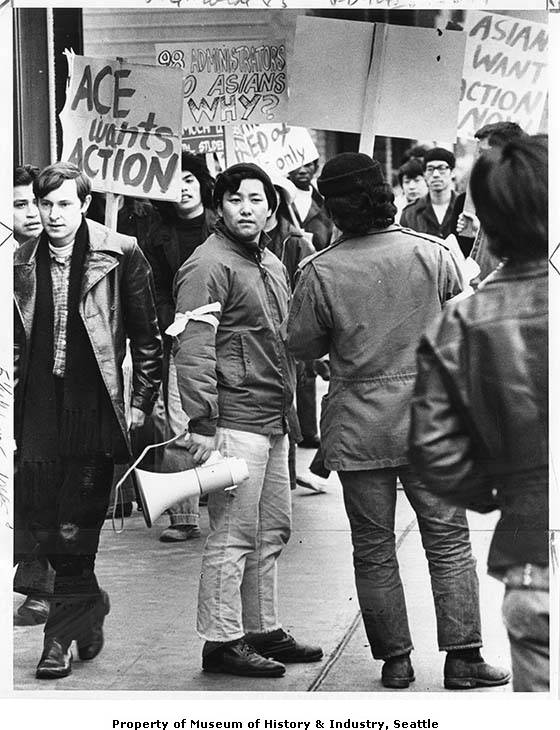
  9. Mike Tagawa leading OSU demonstration, Seattle, February 9, 1969. MOHAI, Seattle Post-Intelligencer Photograph Collection, 2000.107.171.18.01
  10. The 1971 Sit-In: A 17 Minute Recollection of the OSU's Direct Action Campaign to Get Seattle Central Community College to Hire an Asian Administrator. The Seattle Civil Rights and Labor History Project. University of Washington, 2004. http://depts.washington.edu/civilr/sugiyama.htm. 
  11. “Oriental Student Union Sit-In.” Seattle Civil Rights and Labor History Project. Accessed June 15, 2022. https://depts.washington.edu/civilr/aa_osu.htm. 
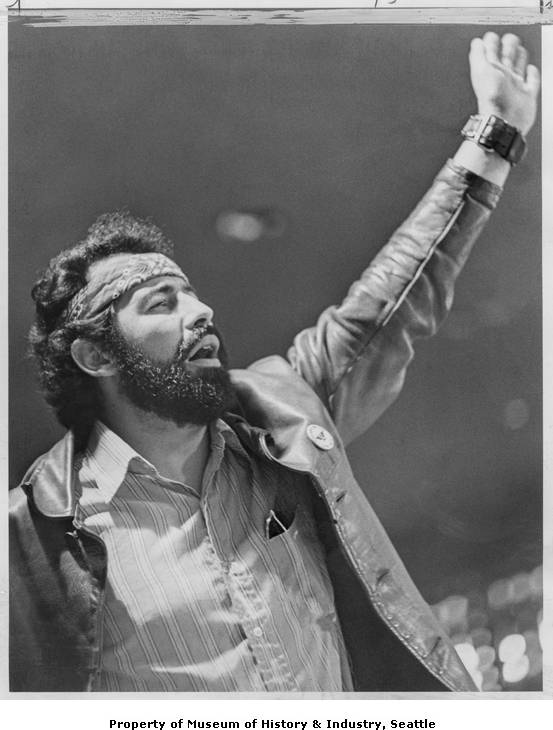
  12. Larry Gossett leading students at BSU UW protest, May 20, 1968, Seattle Post-Intelligencer Collection, MOHAI, 1986.5.16852.15
  13. Robinson, Marc. “The Early History of the UW Black Student Union.” Seattle Civil Rights and Labor History Project. Accessed June 14, 2022. https://depts.washington.edu/civilr/BSU_beginnings.htm. ​
  14. Peterson, Jackie. "Central District: Seattle's Hub for Black Creativity and Community" HistoryLink.tours. Accessed August 18, 2022. https://historylink.tours/tour/central-district. 
0 Comments

8/6/2021 0 Comments

Forced Sterilizations in Washington

Written by Nia

​Content Warning: This article contains talk about rape, eugenics, and forced sterilizations.


Read More
0 Comments

7/30/2021 0 Comments

History of Redlining in Seattle

Written by Cherlyn
Picture
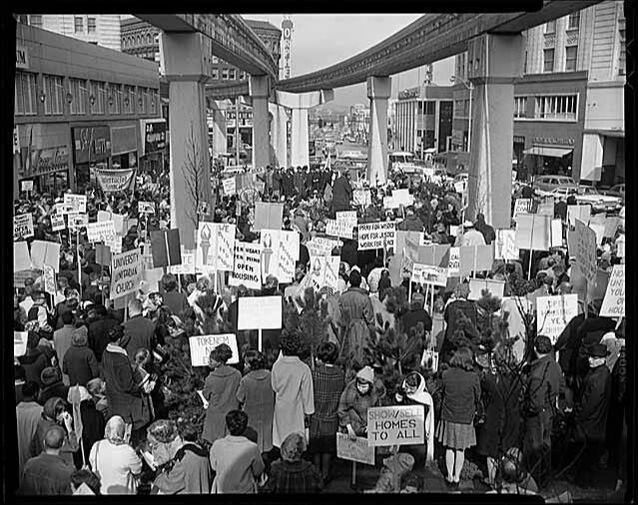
Civil rights supporters demonstrate at Westlake Plaza, Seattle, March 7, 1964. MOHAI Seattle Post-Intelligencer Collection, 1986.5.9654.
​Though Seattle is regularly depicted as a liberal utopia, not too long ago we were practicing some of the same racist tactics that are often looked down upon as something uniquely practiced in the deep South. Banks and white home and land owners refused to give loans or sell homes to non-white customers, which barricade people of color from developing generational wealth in the form of property assets.
Picture
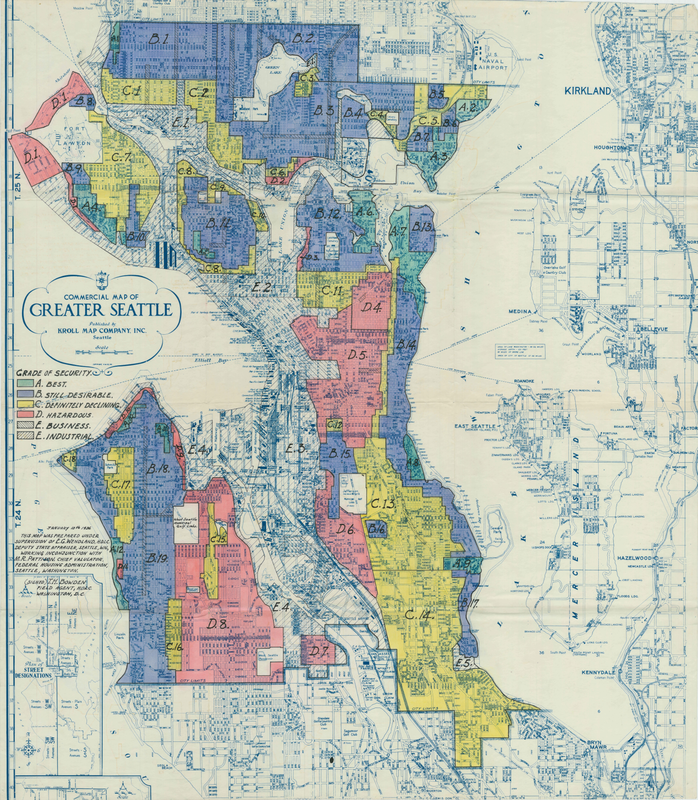
Source: National Archives and Records Administration
​Attempting to stabilize after foreclosures during the Great Depression, the federal government put together maps for banks such as this one from 1936. It shows which neighborhoods are “desirable” based on the predicted safety of mortgages. The desirability of these areas was determined by housing conditions, neighborhood incomes, but also their racial makeup. Armed with this map, banks and financiers began distributing loans with the condition that the proposed land not be inhabited by non-white people to secure home owners that they believed would get them their money's worth. Any neighborhood that allowed non-white residents would automatically be considered “hazardous” (in the red zone, which is where the term redlining comes from). Mortgages for homes in this area were very hard to get, which prevented communities of color from accumulating wealth through property ownership.  The “best” neighborhoods were quickly bought out by white customers and Seattle’s communities of color were further pushed into “hazardous” ones. Home owners, neighborhood groups, real estate agents, and developers in white-dominated communities also enforced residential segregation by putting racially restrictive housing covenants into property deeds that stated that homes couldn’t be sold to specific ethnic or racial groups. By the 1970’s, the Central District was home to about 70 percent of the city’s Black population.  

The U.S. Supreme Court struck down racist housing covenants in 1948, though some Seattle deeds still contain them. In 1968, local and federal fair housing laws were put into place that made it illegal to discriminate on the basis of race when selling or renting housing. These efforts were led by community leaders alongside the civil rights movement. In Seattle, non-discriminatory housing was passed by the City Council and signed by the mayor, only three weeks after the assassination of Dr. Martin Luther King Jr. Even with this implementation of “equality”, unwritten or altered versions of redlining policies and overt discrimination continued to be used into the next decade. 

We still see the impacts of these policies in the racial makeup of neighborhoods and schools today. According to a study of 2018 Census Bureau data done for the Seattle Times, North Seattle neighborhoods remain mostly white; Madison Park/Broadmoor for example, was tied for least-diverse with Fauntelroy/Gatewood in West Seattle, with a population of 89% white people. Southern neighborhoods like Federal Way, White Center, and Rainier Beach were ranked among the most diverse; in the northern end of Federal Way, no single racial group made up more than 28% of the population. With less access to generational wealth due to these historic practices and continuing income inequality, communities of color continue to be subjected to lower quality living conditions because of an inability to acquire desirable property. Resilient communities have formed in these formerly “dangerous” areas, but forces like gentrification threaten the stability and resources they have built for themselves. 

Sources: 
​
  • Balk, Gene. “The Most and Least Diverse Places in King County.” The Seattle Times, The Seattle Times, February 3, 2020, www.seattletimes.com/seattle-news/data/federal-way-to-vashon-island-here-are-the-most-and-least-diverse-places-in-king-county/.
  • Green, Marcus Harrison, “See how a Seattle artist is telling the painful story of redlining in his city,” The Seattle Times, August 7, 2019, https://www.seattletimes.com/seattle-news/artists-exhibit-explores-history-lingering-impact-of-seattle-redlining/. 
  • Henderson, Jamala. “Why Is Seattle so racially segregated?” KUOW, September 20, 2016, www.kuow.org/stories/why-seattle-so-racially-segregated.
  • ​KCTS9. “The History of Redlining in Seattle.” YouTube, November 20, 2018, www.youtube.com/watch?v=mBQE5rrWDfA.
  • “Seattle Open Housing Campaign Digital Document Library.” Digital Document Libraries, Seattle Municipal Archives, Accessed June 2021, www.seattle.gov/cityarchives/exhibits-and-education/digital-document-libraries/the-seattle-open-housing-campaign. 
0 Comments
<<Previous
Forward>>

    Categories

    All Places And Spaces Profiles Then And Now Youth Activism

    Archives

    August 2026
    March 2026
    January 2026
    August 2025
    December 2024
    January 2024
    November 2023
    October 2023
    September 2023
    August 2023
    February 2023
    November 2022
    October 2022
    September 2022
    August 2021
    July 2021
    May 2021

    RSS Feed

Follow us on Instagram!
Listen to the podcast and find show notes at mohai.org